
|
`-=[]⟨⟩\;',./~!@#$%^&*()_+{}|:"<>? 𝑎𝑏𝑐𝑑𝑒𝑓𝑔ℎ𝑖𝑗𝑘𝑙𝑚𝑛𝑜𝑝𝑞𝑟𝑠𝑡𝑢𝑣𝑤𝑥𝑦𝑧
Å − × ⋅∓±∘꞊﹦∗∙ ℯ 𝔸𝔹ℂ𝔻𝔼𝔽𝔾ℍ𝕀𝕁𝕂𝕃𝕄ℕ𝕆ℙℚℝ𝕊𝕋𝕌𝕍𝕎𝕏𝕐ℤ𝐴𝐵𝐶𝐷𝐸𝐹𝐺𝐻𝐼𝐽𝐾𝐿𝑀𝑁𝑂𝑃𝑄𝑅𝑆𝑇𝑈𝑉𝑊𝑋𝑌𝑍
∼∽∾≁≂≃≄≅≆≇≈≉≌≐≠≡ ≤≥≦≧≨≩≪≫
∈∉∊∋∌∍ ⊂⊃⊄⊅⊆⊇ 𝛼𝛽𝛾𝛿𝜀𝜁𝜂𝜃𝜄𝜅𝜆𝜇𝜈𝜉𝜊𝜋𝜌𝜎𝜏𝜐𝜑𝜒𝜓𝜔
∀∂∃∅⦰∆∇∎∞∝∴∵ ∏∐∑⋀⋁⋂⋃ ∧∨∩∪
∫∬∭∮∯∰∱∲∳ ∥⋮⋯⋰⋱ ‖ ′ ″ ‴ ⁄ ⁗ ʹ ʺ ‵ ‶ ‷
﹁ ﹂ ﹃ ﹄ ︹ ︺ ︻ ︼ ︗ ︘ ︿ ﹀ ︽ ︾ ﹇ ﹈ ︷ ︸ ⏜ ⏝ ⎴ ⎵ ⏞ ⏟ ⏠ ⏡
←↑→↓↤↦↥↧↔↕↖↗↘↙▲▼◀▶↺↻⟲⟳ ↼↽↾↿⇀⇁⇂⇃⇄⇅⇆⇇ ⇐⇑⇒⇓⇔⇌⇍⇏⇕⇖⇗⇘⇙⇙⇳⥢⥣⥤⥥⥦⥧⥨⥩⥪⥫⥬⥭⥮⥯
Draft for Information Only
Content
Pollard's p-1 Method
Pollard's p-1 MethodPollard's p-1 method is a prime factorization algorithm discovered by John Pollard in 1974. Limited by the algorithm, the Pollard's p-1 method is only work for integers with specific factors. One issue of the Pollard's p-1 method by smooth number is the value of k is usually much larger than needed in order to ensure p-1 divides k. Therefore alternative selection of k are developed to reduce the time of computation. Alternative methods of selection of k are
Although these methods can reduce the value of k, there is also the possibility that the prime factor p with p-1 is B-smooth of a number n is excluded such that p-1 does not divide k. PowerSmooth Number MethodPowerSmooth NumberAnother number choosing method for integer k is the making use of the concept of powersmooth number and the specific type of prime factor, i.e. p-1 is the product of primes. Let x and B be integers. x is said to be B-powersmooth if all the prime power for dividing n are less than or equal to B. 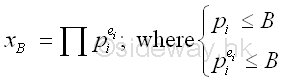
Example of PowerSmooth Number
Unlike smooth number, B is usually considered as the maximum boundry of a group of number. Therefore B can be prime number or composite number providing that B is greater than or equal to the largest prime power factor of x. The key information from a B-powersmooth number is the prime power factor of a number. The lowest B-powersmooth of a number is larger than or equal to the greatest prime power factor of the number. Unlike B-smooth number, B-powersmooth number represents a finite set of numbers. Imply 
Therefore, x can be defined as the least common multiple of the numbers from 1 to B. Imply 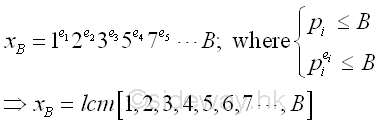
Pollard's P-1 Methed by PowerSmooth NumberSince p-1 divides k, by assuming p-1 is B-powersmooth, if k is also B-powersmooth then the choosen integer k should be sufficienly large to ensure p-1 divides k. Therefore k is equal to the least common multiple of all numbers less than and equal to B. Imply 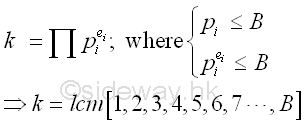
Let k equal to xB. Assume p-1 is B-powersmooth, then p-1 divides k. Pollard's P-1 Method by PowerSmooth Number Example 1For example: n=203=p*q=7*29; let B=5 imply
Therefore for B=5, kfor B=5, k5 or (p5-1)m5 is equal to 60. Fermat's Little Theoremlet a=2, by Fermat's little theorem, let p be one of the prime factors of n, imply p divides ak-1. 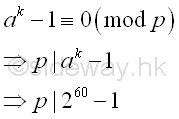
Greatest Common DivisorSince ak-1 is a very large number, before finding the greatest common divisor of n and ak-1, ak-1 can be raised to the high power modulo n. Imply Using squarings modulo
Imply 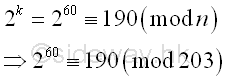
The greatest common divisor of n and ak-1 is Using Euclid's algorithm
Imply 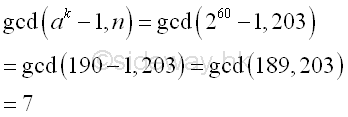
Integer 7, the greatest common divisor of n and ak-1 is also the prime divisor of n. And p-1 is 5-powersmooth.
Since the greatest prime power factor of p-1 is 3-smooth also. And therefore the prime factor 7 can also be found by using B=3
let a=2, by Fermat's little theorem, imply p divides 26-1 ≡ 63 (mod 203) The greatest common divisor of n and ak-1 is gcd(63,203)= 7 And 7 is the prime divisor of n as before. ©sideway ID: 120500009 Last Updated: 5/17/2012 Revision: 0 Latest Updated Links
  Nu Html Checker Nu Html Checker  53 53  na na  na na |
 Home 5 Business Management HBR 3 Information Recreation Hobbies 9 Culture Chinese 1097 English 339 Travel 53 Reference 79 Hardware 55 Computer Hardware 261 Software Application 213 Digitization 37 Latex 52 Manim 205 KB 1 Numeric 19 Programming Web 290 Unicode 504 HTML 66 CSS 65 Selector 1 SVG 46 ASP.NET 270 OS 447 MS Windows DeskTop 7 Python 72 Knowledge Mathematics Formulas 8 Set 1 Logic 1 Algebra 84 Number Theory 207 Trigonometry 31 Geometry 34 Calculus 67 Engineering Tables 8 Mechanical Rigid Bodies Statics 92 Dynamics 37 Fluid 5 Control Acoustics 19 Natural Sciences Matter 1 Electric 27 Biology 1 |
Copyright © 2000-2026 Sideway . All rights reserved Disclaimers last modified on 06 September 2019
