
ElectricElectric ForcePolarizationInsulatorElectric Field of Charged RodElectric Field of Charged Ring, Disk, and PlaneElectric Field of Charged Spherical ShellPotential EnergyPotential DifferenceElectric PotentialElectric EnergyElectric CurrentMagnetic FieldKirchhoff's Current LawSteady StateCapacitor Charge and DischargeRC Circuit Time ConstantCurrent Density, Conductivity
`-=[]⟨⟩\;',./~!@#$%^&*()_+{}|:"<>? 𝑎𝑏𝑐𝑑𝑒𝑓𝑔ℎ𝑖𝑗𝑘𝑙𝑚𝑛𝑜𝑝𝑞𝑟𝑠𝑡𝑢𝑣𝑤𝑥𝑦𝑧
Å − × ⋅∓±∘꞊﹦∗∙ ℯ 𝔸𝔹ℂ𝔻𝔼𝔽𝔾ℍ𝕀𝕁𝕂𝕃𝕄ℕ𝕆ℙℚℝ𝕊𝕋𝕌𝕍𝕎𝕏𝕐ℤ𝐴𝐵𝐶𝐷𝐸𝐹𝐺𝐻𝐼𝐽𝐾𝐿𝑀𝑁𝑂𝑃𝑄𝑅𝑆𝑇𝑈𝑉𝑊𝑋𝑌𝑍
∼∽∾≁≂≃≄≅≆≇≈≉≌≐≠≡ ≤≥≦≧≨≩≪≫
∈∉∊∋∌∍ ⊂⊃⊄⊅⊆⊇ 𝛼𝛽𝛾𝛿𝜀𝜁𝜂𝜃𝜄𝜅𝜆𝜇𝜈𝜉𝜊𝜋𝜌𝜎𝜏𝜐𝜑𝜒𝜓𝜔
∀∂∃∅⦰∆∇∎∞∝∴∵ ∏∐∑⋀⋁⋂⋃ ∧∨∩∪
∫∬∭∮∯∰∱∲∳ ∥⋮⋯⋰⋱ ‖ ′ ″ ‴ ⁄ ⁗ ʹ ʺ ‵ ‶ ‷
﹁ ﹂ ﹃ ﹄ ︹ ︺ ︻ ︼ ︗ ︘ ︿ ﹀ ︽ ︾ ﹇ ﹈ ︷ ︸ ⏜ ⏝ ⎴ ⎵ ⏞ ⏟ ⏠ ⏡
←↑→↓↤↦↥↧↔↕↖↗↘↙▲▼◀▶↺↻⟲⟳ ↼↽↾↿⇀⇁⇂⇃⇄⇅⇆⇇ ⇐⇑⇒⇓⇔⇌⇍⇏⇕⇖⇗⇘⇙⇙⇳⥢⥣⥤⥥⥦⥧⥨⥩⥪⥫⥬⥭⥮⥯
Draft for Information Only
ContentMagnetic Force
Magnetic Force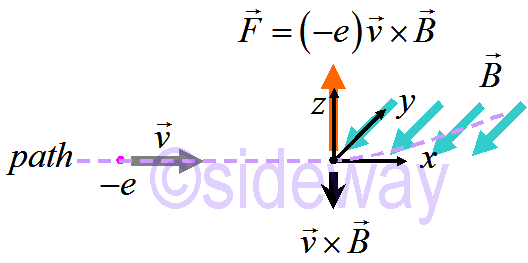 For an electron charge −𝑒, the magnetic force on a moving electron is in opposite direction to the direction of the cross product
 𝑣× 𝐵 Motion in a Magnetic Field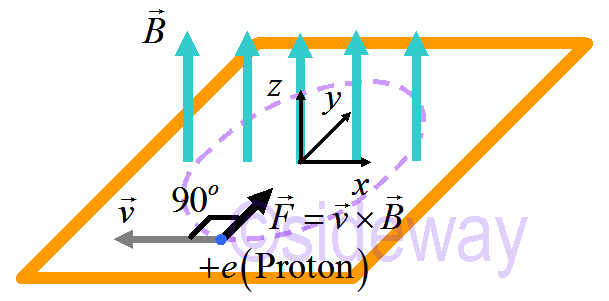 In a large area with constant 𝐵⊥𝑣.
𝐵=
𝑞and Biot-Savart law of current in a wire 𝐵=
𝑙× Magnetic Force in a Wire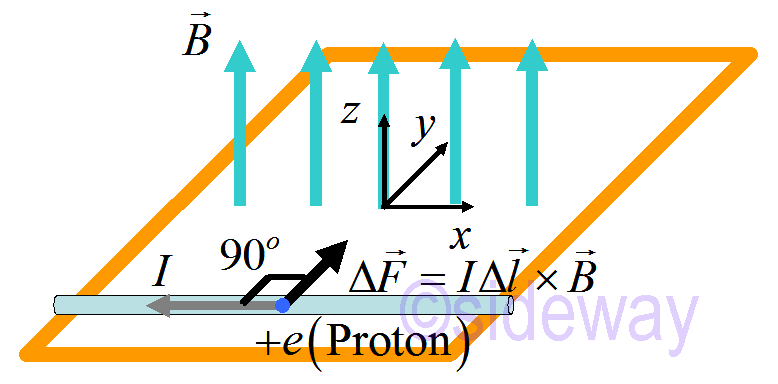 The magnetic force due to point charge is ∆
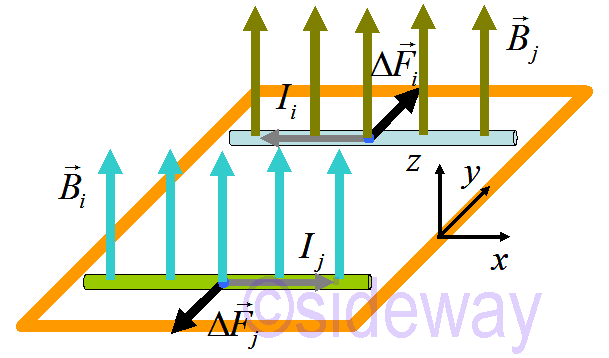
𝐹mag=𝑞 𝑣× 𝐵and magnetic force due to current in a wire is 𝐹mag=𝐼∆ 𝑙× 𝐵 Magnetic Force between Parallel WiresWhen currents flow in two paralle wire are in same direction, two parallel wires attract each other.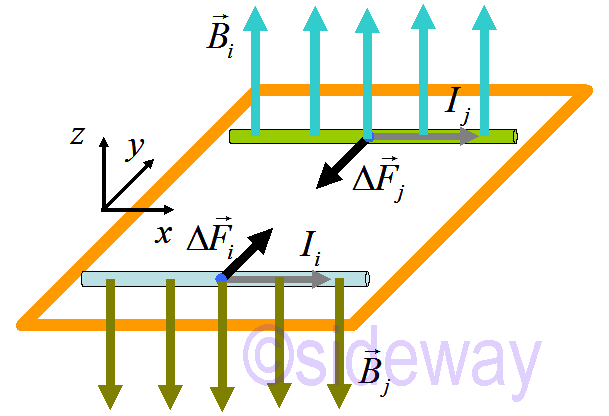 When currents flow in two paralle wire are in opposite direction, two parallel wires repel each other
Hall EffectBy measuring the Hall effect for a particular material, the sign of the moving particles that make up the current can be determined. Why would it be anything other than electrons, negative charges. Semiconductors: sometimes currents is carried by electrons, but sometimes it is carried by the holes. In semiconductors, holes, missing electrons, in the electron sea behave like positive charges.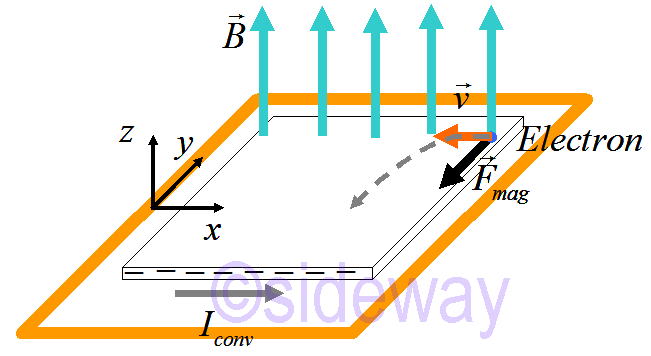 When electron current flows through a metal bar under a magnetic field, all moving electrons will be pushed to one side near the bottom. Negative charges are built up one side and expose atomic cores at the other side near the top. In other words, a polarization is built up on the bar by stucking electrons on one side. The electron current will move straight forward again when the gathered charges on the bottom are strong enough to prevent electrons from getting defected by balancing the magnetic force. A voltage difference ∆𝑉 is induced in the metal bar.
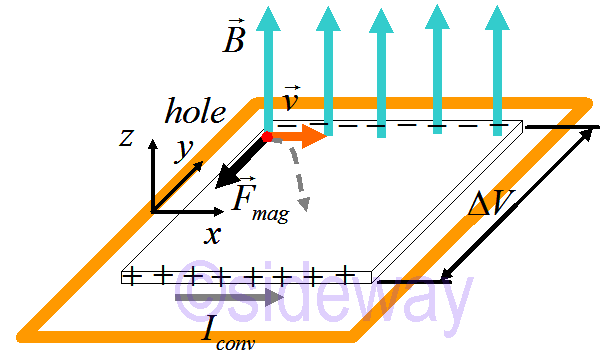 Similarly, when conventional current of holes flows through a material bar under a magnetic field, all moving holes will be pushed to one side near the bottom. Positive holes are built up on one side and expose negative charges at the other side near the top. In other words, a polarization is built up on the bar by stucking hole on one side. The positive hole current will move straight forward again when the gathered holes on the bottom are strong enough to prevent holes from getting defected by balancing the magnetic force. A hall voltage ∆𝑉 is induced in the material bar. The hall voltage due to holes is opposite to the voltage due to electrons.
Source and Referencehttps://www.youtube.com/watch?v=P-5wV6rt_Aw&list=PLZ6kagz8q0bvxaUKCe2RRvU_h7wtNNxxi&index=19©sideway ID: 200100902 Last Updated: 1/9/2020 Revision: 0 Latest Updated Links
  Nu Html Checker Nu Html Checker  53 53  na na  na na |
 Home 5 Business Management HBR 3 Information Recreation Hobbies 9 Culture Chinese 1097 English 339 Travel 64 Reference 79 Hardware 55 Computer Hardware 263 Software Application 213 Digitization 37 Latex 52 Manim 205 KB 1 Numeric 19 Programming Web 290 Unicode 504 HTML 66 CSS 65 Selector 1 SVG 46 ASP.NET 270 OS 447 MS Windows DeskTop 7 Python 72 Knowledge Mathematics Formulas 8 Set 1 Logic 1 Algebra 84 Number Theory 207 Trigonometry 31 Geometry 34 Calculus 67 Engineering Tables 8 Mechanical Rigid Bodies Statics 92 Dynamics 37 Fluid 5 Control Acoustics 19 Natural Sciences Matter 1 Electric 27 Biology 1 |
Copyright © 2000-2026 Sideway . All rights reserved Disclaimers last modified on 06 September 2019
