The Fundamentals of Geometric Figures
   Dimensions
   Elements of Geometric Figures
The Fundamentals of Geometric Figures
Geometry is the study of figures. There are many ways to describe a
figure
Dimensions
In general, a dimension is a phsical measurement of size, length,
or distance in one direction. A dimension is also a descriptive
measurement of the intrinsic property of an object.
Elements of Geometric Figures
The fundamental notions of
geometry.
A point is a primitive notion that has no dimensional
attribute, 0-dimensional. A point can lie in a line, in a line, or in space.
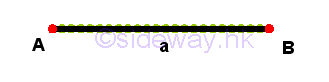
A line or straight line is a length
notion that has one linear dimensional attribute called length, 1-dimensional. A
line has no breadth, and thickness and can lie in a plane or in space.
The extremities of a line are points.
A plane,
flat plane or Euclidean plane is an area notion
that has two linear dimensional attributes called length and breadth,
2-dimensional. A plane has no thickness and can lie in space.
The extremities of a plane are lines and the extremities of a line are points.
Therse points are called vertices.
A space,
cuboid space or Euclidean space is an volume
notion that has three linear dimensional attributes called length, breadth, and
thickness, 3-dimensional.
The extremities of a plane are lines and the extremities of a line are points.
The extremities of a space are planes, the extremities of a plane are lines and
the extremities of a line are points. Therse points are called vertices.
The fundamental objects of
geometry for describing geometric figures.
A vertice is a 0-dimensional object
but a vertice can lie in higher dimensional. A
vertice itself has no length, breadth, and thickness.
A curve is a 1-dimensional object
but a curve can lie in higher dimensional. A
curve itself has no breadth and thickness.
A surface is a
2-dimensional object but a surface can lie in higher dimensional. A
surface itself has no thickness.
A
solid is a 3-dimensional object and a solid can lie in
space only.
The fundamental elements of geometric figures.
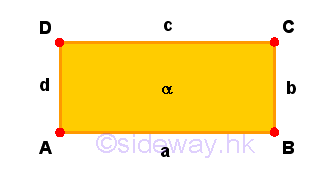
A two dimensional figure, also called plane figure or
planar figure, is a 2-dimensional object
lying in a single plane but a planar figure can lie in higher dimensional.
A planar figure is a set of line segments and curve segments, which are also
called sides and arcs. The sides and arcs of a two dimensional figure are called
the edges of the figure. The edges themselves are one-dimensional object, but
the edges lie in the two-dimensional plane forming a two dimensional figure. The
interections of the edges are called the vertices or corners. Usually a vertex
is refered to the end point of at least two edges, sometime a vertex can also be
used to name the end point of the loose end of an edge. These vertices or points
are zero-dimensional, but points lie in a one dimensional line in the
two-dimensional plane.
A three dimensuon figure, also called solid figure, is a
3-dimensional object
lying in three dmensional space only.
A solid figure is a set of plane regions and surface regions, which are also
called surfaces. The surfaces of a three dimensional figure are called the faces
of the figure. The face themselves are two-dimensional object, but the faces lie
in the three dimensional space forming a three dimensional figure. The sides and
arcs that are the edges of the faces of the solid figure are called the edges of
the figure. The edges themselves are one-dimensional object, but the edges lie
in the two-dimensional space forming a two dimensional figure in three
dimensional space. Similarly, the interections of the edges are called the
vertices or corners of the solid figure. These vertices are zero-dimensional,
but points lie in the two-dimensional plane in three dimensional space.


 Nu Html Checker
  53
53  na
na  na
na